There’s something satisfying about leaving a conference with pages of notes.
You’ve listened to speakers, engaged with research, challenged some of your thinking and probably identified several ideas worth exploring.
You leave feeling that you’ve learnt something.
But what happens when you return to school?
The lessons still need teaching, assessments need marking and the usual demands of school life continue. Some ideas might make their way into classroom practice. Others may remain in the notebook.
It was a brilliant day of professional learning. But how do we build on what we’ve learnt?
On Saturday 14 November 2026, I attended Qatar’s first researchED conference, hosted by Mesaieed International School.
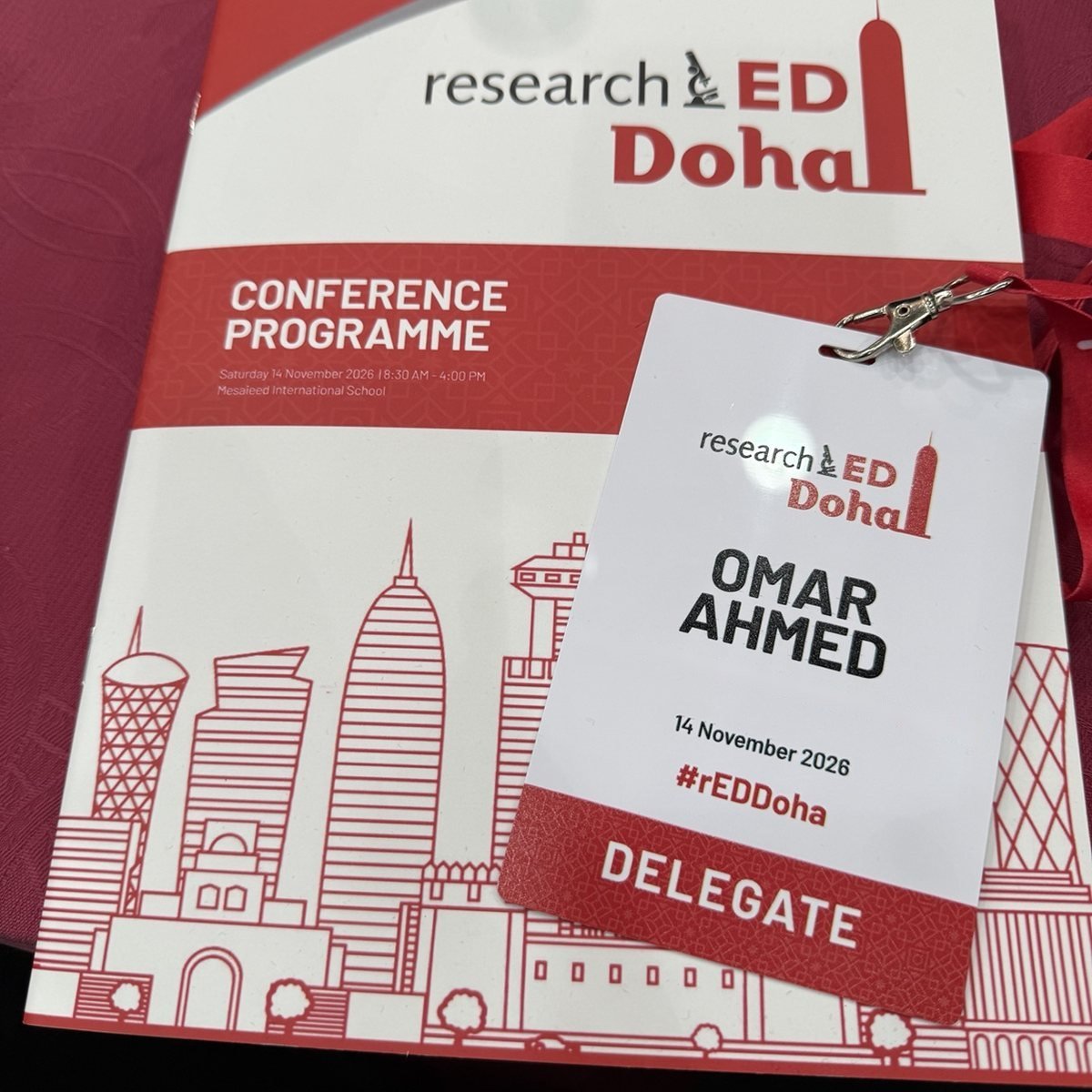
Having previously led whole-school teaching and learning, developed instructional coaching and researched the implementation of a pedagogical framework as part of my Master’s, I was particularly interested in how research could translate into everyday classroom practice.
Across the day, I attended sessions exploring scaffolding, professional development, pedagogical frameworks, educational myths, adaptive teaching and psychological safety.
Different topics, but I found myself returning to a common question.
How do we distinguish participation from genuine improvement?
It’s a question that applies just as much to what happens in our classrooms as it does to the professional development we provide teachers.
When doing isn’t the same as learning
Consider a pupil completing an extended Biology question.
The teacher provides a worked example, identifies the key scientific vocabulary and offers sentence starters to support the response.
The pupil completes the question successfully.
From the outside, it looks like progress. The work is accurate, the pupil has completed the task and the support appears to have worked.
But what has the pupil actually learnt?
Could they answer a similar question without the sentence starters? Would they remember the explanation in a week’s time? Could they apply their understanding in a different context?
These questions matter because successful task completion doesn’t necessarily demonstrate secure learning.
The opening keynote from Rachel Ball and Dr Alex Fairlamb explored five principles of effective scaffolding. Their discussion made me revisit Vygotsky’s concept of the Zone of Proximal Development (ZPD).
Vygotsky (1978) described the difference between what a learner can achieve independently and what they can achieve with appropriate guidance or collaboration.
This provides a useful theoretical lens for understanding the role of support in learning.
Although the instructional scaffolding metaphor was developed separately by Wood, Bruner and Ross (1976), the concepts are closely related.
Scaffolding can help pupils access learning that they might initially struggle to complete independently. This might involve modelling, worked examples, prompts or breaking a complex task into manageable steps.
But the intention should be to develop independence, not simply produce a correct answer.
If the support remains in place, how do we know whether pupils can succeed without it?
Imagine teaching pupils to explain how blood glucose concentration is regulated.
Initially, a teacher might model an explanation using key terms such as insulin, glucagon, pancreas and glycogen.
Pupils might then complete a similar explanation using prompts.
As their understanding develops, the support can be reduced. They may be asked to explain the process independently or apply their knowledge to a different situation.
The important part isn’t simply removing the scaffold. It’s deciding when pupils are ready and checking what they can now do independently.
This connected with Leanne Kennedy’s session on moving from traditional differentiation towards adaptive teaching.
Her discussion of high-quality universal provision reinforced the importance of maintaining ambitious learning goals while responding to pupils’ needs.
Adaptive teaching shouldn’t automatically mean creating different tasks or reducing the level of challenge.
Instead, we should consider what pupils need to access the learning and how that support can be adjusted as their understanding develops.
There is a balance to strike.
Too little support may leave pupils unable to access the task. Too much support may allow them to complete it without developing the understanding we intended.
The aim isn’t to make the task easier. It’s to make the learning accessible while developing greater independence.
Are we looking for techniques or effective teaching?
The distinction between what we can observe and what we can reasonably conclude also applies to teaching and learning frameworks.
Nick Hart’s session explored why schools need pedagogical frameworks and how they should be positioned.
His discussion of autonomy, alignment and standardisation particularly interested me.
Having previously led the implementation of a whole-school teaching and learning framework, I’ve spent considerable time thinking about what consistency should look like across classrooms.
Schools need shared expectations, but consistency doesn’t necessarily mean every teacher doing exactly the same thing.
Consider a school where checking for understanding is a priority.
During a learning walk, a teacher might use mini-whiteboards to gather responses. Another might use cold calling to probe pupils’ explanations. A third might use a carefully selected question to identify misconceptions.
Different techniques, but potentially the same underlying purpose.
However, the presence of a technique doesn’t automatically mean it is being used effectively.
A teacher could use mini-whiteboards throughout a lesson without asking questions that reveal much about pupils’ understanding.
Another could use cold calling but provide insufficient thinking time, limiting the quality of responses.
In both cases, the technique is present. But is it achieving what the teacher intended?
One consideration when implementing pedagogical frameworks is ensuring that the focus remains on the quality of teaching, rather than simply whether particular strategies are visible.
This is where Nick’s distinction between alignment and standardisation becomes important.
A framework should help establish a shared understanding of effective teaching while allowing teachers to exercise professional judgement about how those principles are applied.
Consistency should be about the principles underpinning effective teaching, not simply everyone demonstrating the same techniques.
This also has implications for professional development.
Rather than simply introducing teachers to a strategy, we need to help them understand what effective implementation looks like and how they can evaluate whether it is working.
Knowing what to do doesn’t mean we can do it
The same challenge appears when we consider how teachers develop their practice.
Rachel Ball’s session on the mechanisms of effective professional development drew on the Education Endowment Foundation’s (EEF) Effective Professional Development guidance (2021).
The guidance identifies 14 mechanisms organised around four broad areas: building knowledge, motivating teachers, developing teacher techniques and embedding practice.
What particularly interested me was the distinction between understanding an approach and being able to implement it effectively.
Imagine a CPD introducing cold calling.
Teachers might understand the rationale, recognise the potential benefits and feel motivated to use it.
But what happens when they try it?
A pupil says they don’t know the answer. Another gives an incorrect response. Several pupils appear reluctant to participate.
The teacher now needs to make decisions about thinking time, prompting, questioning and how to respond.
Knowing why a technique might be effective doesn’t automatically mean we have developed the expertise to use it well.
This is where modelling, rehearsal and feedback become important.
Teachers may benefit from observing the technique being demonstrated, practising it themselves and receiving feedback before refining it in their classrooms.
Even then, developing expertise takes time.
This connected closely to my Master’s research, which examined instructional coaching as a way of supporting the implementation of a whole-school teaching and learning framework.
Colleagues who participated generally valued opportunities for reflection and feedback. However, practical challenges involving time, consistency and coach availability emerged.
The findings reflected perceptions within one school rather than direct measurements of improvements in teaching or pupil outcomes.
Nevertheless, they raised important questions about the conditions required for professional development to translate into classroom practice.
We can introduce teachers to effective techniques, explain the research and provide examples of what good practice looks like.
But without opportunities to practise, receive feedback and revisit an approach, how confident can we be that professional development has resulted in meaningful change?
Delivering CPD is a starting point. The real challenge is supporting teachers to develop their practice afterwards.
That distinction matters when schools are working towards a shared understanding of effective teaching.
What if the research challenges what we already believe?
Of course, none of this means that every approach presented as evidence-informed should automatically be adopted.
Joseph Birch’s session on educational myths was a useful reminder of the importance of critically evaluating research.
Educational ideas can become popular because they offer seemingly straightforward solutions to complex classroom problems.
But research is rarely that simple.
Findings can be misunderstood, applied beyond their original context or presented with greater certainty than the evidence supports.
Even familiar concepts deserve careful consideration.
For example, Vygotsky’s ZPD is often discussed alongside scaffolding, sometimes as though the two are interchangeable.
Although closely connected in educational discussions, they have different theoretical histories.
That distinction might seem minor, but it illustrates why understanding the research matters.
Being evidence-informed isn’t simply about identifying techniques that appear to be supported by research.
We need to consider what the evidence actually tells us, what its limitations are and whether an approach is appropriate for the context in which we intend to use it.
Sometimes research reinforces what we’re already doing.
At other times, it should make us question our assumptions.
The purpose of engaging with research isn’t to confirm that we’re right. It’s to help us make better decisions.
Improvement needs more than good intentions
There’s another important consideration when we ask teachers to reflect on and develop their practice.
They need to feel comfortable discussing what isn’t working.
Sam Crome’s session on psychological safety explored the relationship between trust, accountability and team performance.
One of the ideas that stood out was that psychological safety and accountability shouldn’t be viewed as opposing priorities.
Teachers should feel able to ask questions, acknowledge mistakes and challenge ideas without fearing that every professional conversation will become a judgement of their competence.
But that doesn’t mean removing expectations or avoiding difficult conversations.
Consider a teacher who has been working on improving their questioning.
During a coaching conversation, they recognise that their questions aren’t consistently revealing misconceptions.
Will they feel comfortable discussing this openly?
Or will they be more concerned about demonstrating that the technique is being implemented successfully?
Professional conversations are most valuable when teachers can reflect honestly on their practice and identify meaningful next steps.
Equally, simply reassuring colleagues that everything is going well doesn’t necessarily help them develop.
Constructive feedback requires professional challenge alongside support.
Psychological safety should make it easier to discuss areas for improvement, while maintaining the expectation that we continue to develop.
Sam’s closing keynote, Beyond the Notepad, brought much of this thinking together.
Professional learning can begin with an individual attending a conference or engaging with research.
But sustained improvement requires opportunities to discuss, develop and revisit what has been learnt.
An interesting idea is a starting point.
What matters is how that idea is understood, applied and evaluated.
What does the research tell us?
The EEF’s Effective Professional Development guidance (2021) provides a useful basis for considering how professional learning can support changes in practice.
However, the guidance doesn’t suggest that every CPD must contain all 14 mechanisms or that including them guarantees improvement. The quality and relevance of implementation still matter.
The EEF’s A School’s Guide to Implementation (2024) also highlights the importance of creating the conditions needed to introduce and sustain evidence-informed approaches.
Implementation is not a single event. It requires ongoing attention, support and adaptation.
Research on psychological safety offers another perspective.
Edmondson (1999) found an association between psychological safety and learning behaviour in organisational teams. Although this research was not conducted specifically in schools, it provides a useful perspective on the conditions that may encourage colleagues to discuss mistakes, seek feedback and learn together.
We should be careful about the conclusions we draw from this evidence.
Research can inform how we design professional development, but it doesn’t guarantee that a particular programme will improve teaching or pupil outcomes.
Similarly, positive feedback from a CPD tells us something about participants’ experiences, but not necessarily whether classroom practice has improved.
This is a distinction I’ve become increasingly conscious of throughout my work in teaching and learning.
Participation, implementation and improvement are not the same thing.
A teacher attending professional development demonstrates participation.
A teacher beginning to use a new approach demonstrates some level of implementation.
But understanding whether that approach has improved their teaching requires further evidence.
We need to consider the quality of implementation and, ultimately, whether it is helping pupils learn.
What am I taking away?
The day after researchED Doha, I attended the Steplab Professional Development Leadership Intensive.
Across the two days, much of what I heard reinforced my existing thinking about instructional coaching, professional development and school improvement.
But it also encouraged me to reflect on my own experiences.
Having previously led whole-school CPD, developed teaching and learning frameworks and supported teachers through coaching, I know how much work goes into planning and delivering professional development.
Yet delivering something successfully isn’t necessarily the same as achieving the improvement we intended.
Looking back, I think some of the most important questions are the ones we ask afterwards.
What have teachers actually taken away? What are they doing differently? What difficulties have emerged? And how do we know whether their practice has improved?
These questions aren’t always easy to answer.
Teaching is complex, professional expertise develops over time and a single observation rarely tells us everything about the quality of classroom practice.
But that doesn’t make the questions any less important.
If anything, it means we should be thoughtful about the evidence we collect and the conclusions we draw.
Try it after your next CPD
The next time you attend a conference or participate in professional development, choose one idea that has challenged your thinking.
Rather than immediately deciding to introduce it, consider three questions.
1. What have I actually learnt?
Go beyond remembering the name of a technique or understanding its rationale.
What has changed in your understanding of effective teaching?
2. What might I do differently?
Identify a specific aspect of practice that could be refined.
Consider what effective implementation would look like and what support might be needed.
3. How will I know whether it’s made a difference?
Think about what evidence would help you evaluate the change.
Would you expect to see a difference in the quality of pupils’ responses, their ability to work independently or how successfully they apply knowledge?
Then revisit the approach.
The aim isn’t to return from professional development with as many new ideas as possible.
It’s to identify something worthwhile and give it the attention needed to make a difference.
Beyond the conference
researchED Doha provided an opportunity to engage with research, challenge assumptions and reflect on my own practice.
I left with plenty of notes, but also a renewed appreciation of how easily we can mistake visible activity for meaningful improvement.
A pupil completes a scaffolded task. A teacher demonstrates a technique. A colleague attends CPD.
Each provides information, but none tells us everything we need to know.
We still need to consider what has been learnt, how effectively something has been implemented and whether it has made a difference.
For me, that’s what the weekend reinforced.
The value of professional learning isn’t determined by how many strategies we discover or how much information we take away.
It’s in how we use that learning to question, refine and improve our practice.
The conference might be over. The learning shouldn’t be.
References
Edmondson, A. (1999) ‘Psychological Safety and Learning Behavior in Work Teams’, Administrative Science Quarterly, 44(2), pp. 350–383. https://doi.org/10.2307/2666999
Education Endowment Foundation (2021) Effective Professional Development. https://educationendowmentfoundation.org.uk/education-evidence/guidance-reports/effective-professional-development/
Education Endowment Foundation (2024) A School’s Guide to Implementation. Third edition. https://educationendowmentfoundation.org.uk/education-evidence/guidance-reports/implementation/
Vygotsky, L. S. (1978) Mind in Society: The Development of Higher Psychological Processes. Cambridge, MA: Harvard University Press.
Wood, D., Bruner, J. S. and Ross, G. (1976) ‘The Role of Tutoring in Problem Solving’, Journal of Child Psychology and Psychiatry, 17(2), pp. 89–100. https://doi.org/10.1111/j.1469-7610.1976.tb00381.x
researchED Doha (2026) Conference Programme. Mesaieed International School, 14 November 2026.